

AWS Bedrock through a small-shop lens
Bedrock is built for the enterprise integration story. Most of the AWS-doc treatment assumes that audience. Worth working through what the small-shop or solo-developer version of using it actually looks like.


Bedrock is AWS's hosted catalog of frontier and open-weights models, with a consistent API surface across them, governance controls, and tight integration with the rest of the AWS account. The official documentation is written for the enterprise integration story, the customer who's standardizing AI access across business units, who needs SSO and CloudTrail and PrivateLink and per-team budgets, and who's signing a meaningful Enterprise Discount Program agreement. That's a real audience and the product is good for them.
It's not the audience that most "small shop" AI work actually fits. Worth working through what Bedrock is actually useful for if you're a solo developer, a small team, or a project that doesn't have an AWS account team on speed dial.
What Bedrock actually does for you
The thing Bedrock provides that going direct to OpenAI, Anthropic, Google, etc. doesn't:
One API across multiple model families. Bedrock exposes Anthropic, Meta (Llama), Mistral, Cohere, Amazon Nova, Stability, AI21, and a few others through a single InvokeModel call shape. If your code wants to be vendor-agnostic (switching between Claude and Llama and Nova based on the request) Bedrock makes that one set of credentials and one API surface instead of three.
Account-native auth and billing. No new account, no new credit card, no new contract. The invocation goes on your AWS bill, governed by your existing IAM policies, audited in CloudTrail, observable in CloudWatch. For shops that already do their finance through AWS, that's a real reduction in friction.
Data residency and Private Endpoints. Bedrock invocations can be confined to a region, and PrivateLink endpoints mean traffic never touches the public internet. For workloads where the legal team cares which jurisdiction the inference happened in. That's the cleanest path.
Knowledge Bases and Agents. Bedrock's higher-level features. Knowledge Bases (managed RAG), Agents (orchestration over tools), Guardrails (content filtering), are convenience layers that wrap the model call with common patterns. They're useful when you want the integration without building the plumbing.
That's the value proposition. Now the small-shop version.
What to use Bedrock for if you're small
A pragmatic match between Bedrock features and small-shop workloads:
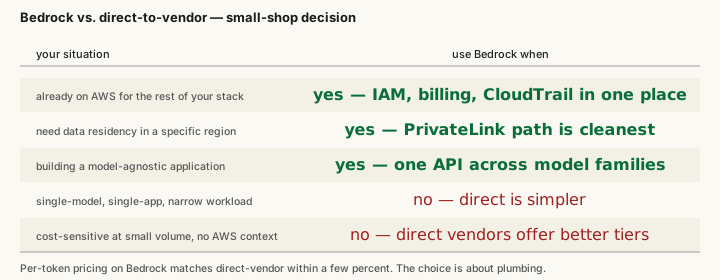
Use Bedrock when your application is already running on AWS and the integration friction matters. If your Lambda functions, ECS tasks, or App Runner services are calling models, the latency, IAM, and billing story of staying in-account is real. The marginal cost of going through Bedrock vs. direct-to-vendor is small enough at low volume that it's not worth the credential management of two systems.
Use Bedrock when you want a single API surface to swap models behind. If you're building anything that wants to be model-agnostic, a chat product, an internal tool that should work whether you're paying for Claude Opus or running on Nova for cost. Bedrock saves you writing the abstraction yourself.
Use Bedrock when the data residency story matters and you can't tolerate the inference happening outside a specific region. The non-Bedrock path here gets thorny fast.
Use Bedrock when you specifically want Anthropic's Claude with the AWS billing relationship. The Anthropic models on Bedrock are real Anthropic models with real Anthropic capabilities; the integration is genuine and for shops that want one bill and one audit trail, that's worth something.
What to skip
A few features that look great in the docs but are usually wrong for small-shop use:
Knowledge Bases as a managed RAG solution. The convenience is real but the cost-per-query is meaningful, and the abstraction hides enough of what's actually happening that debugging when retrieval is wrong becomes hard. For a small team with the engineering cycles to set up pgvector or Qdrant against an open-source embedding model, the build-it-yourself path is usually cheaper and more debuggable. The Knowledge Bases pitch makes the most sense at the enterprise scale where the operational overhead of running your own vector store is itself the cost being saved.
Agents (the Bedrock Agents product). The orchestration model is opinionated in a way that's hard to escape. For agentic workloads in 2025, the field is moving toward MCP-style integration patterns and direct tool-use APIs rather than vendor-managed agent abstractions. Building on Bedrock Agents now means you're building on a layer that's likely to be displaced by your own simpler implementation within the year.
Guardrails as your only safety layer. Useful, but they're a content-filtering wrapper, not a substitute for thinking about what your application should and shouldn't do. The cost overhead is small but the failure mode of "we're protected because we're using Guardrails" is real.
Where the cost story actually lands
A quick sanity check on the per-token economics: Bedrock prices for the same model are usually within a few percent of going direct to the vendor. Anthropic's Claude 3.5 Sonnet on Bedrock is essentially the same per-token cost as going direct to Anthropic. Llama models on Bedrock are competitive with the dedicated open-weights hosts (Together, Fireworks, etc.) but not always cheaper.
The cost differences that matter at small-shop scale aren't the per-token rates, they're the bundled platform features you may or may not be paying for whether you use them, and the engineering time saved (or wasted) by staying inside or going outside the AWS perimeter. For small workloads, the per-call rate is rarely the binding constraint. The "do I want one credential set or three" decision usually is.
What changes for you specifically
A useful framing if you're trying to decide whether to standardize on Bedrock:
If your existing AWS spend on the rest of your stack is high enough that AWS account teams take your call, the enterprise procurement story makes Bedrock easy to justify on the credentials and contract side alone.
If your existing AWS spend is small enough that you're paying full retail for everything, the calculus shifts. Going direct to vendors gives you more flexibility (per-model contracts, better support tiers, faster access to new models), and the "everything in one bill" benefit is less pronounced when the AI bill is most of the bill anyway.
If your workload is narrow (a single model, a single application, a clear integration story) going direct is usually simpler. If your workload is wide (many models, many applications, real governance requirements) Bedrock's wrapping is worth what it costs.
The mistake to avoid is either default. Treating Bedrock as the right answer for every small-shop AI workload is missing the point of why the abstraction exists. Treating it as never-the-right-answer because "it's enterprise" is missing the cases where the bundle genuinely helps. The decision is per-project, and the right one depends more on the existing context of your AWS account than on Bedrock itself.