

Local-first AI: when does it actually beat the cloud?
The case for running AI locally is louder than the math justifies for most workloads. Worth being explicit about which workloads it actually wins, and which ones the cloud still owns.


The local-first AI conversation tends to overshoot in both directions. The enthusiast version says local always wins because privacy, sovereignty, and the warm fuzzy feeling of running your own. The cloud-default version says local is a hobbyist niche because hosted inference is too cheap and the model gap is too wide. Both miss the more interesting question, which is: for which specific workloads does local-first actually beat cloud inference in 2025, and on what dimensions does it lose?
Worth being explicit. The honest answer has more structure than either side of the loud version usually gets to.
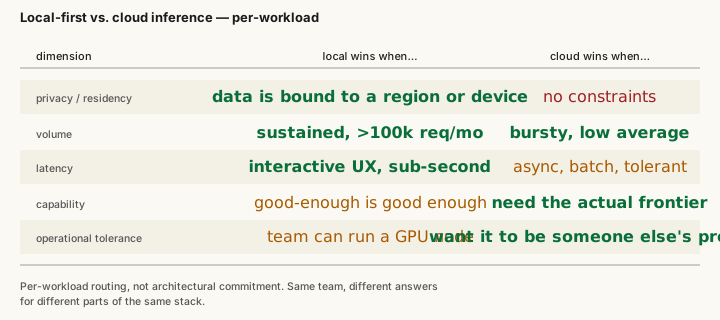
The dimensions that actually matter
Five things that decide where the line falls for any given workload:
Privacy and residency. If the data is sensitive enough that sending it to a third-party model provider is a non-starter, medical records, legal-privileged content, source code under NDA, customer data with residency restrictions, local is the only answer for that workload. The cloud-cost calculation doesn't enter. The cost of not using AI for that workload also doesn't enter; it's a binary.
Volume. A workload that runs the model once per user request, a few hundred times a month, is not where you optimize for cost. The hosted-inference bill at that volume is a rounding error. Local hosting amortizes only at sustained volume, call it a few hundred thousand requests a month, give or take. Below that threshold, the per-call price doesn't beat the operational overhead of running your own inference.
Latency. Hosted inference has a network round trip. Local inference doesn't. For interactive UX where the user is watching a spinner, the latency difference can be the difference between "feels responsive" and "feels broken." For batch and async work, it doesn't matter.
Capability. The local-runnable models are genuinely capable for a lot of workloads in 2025. They are not the absolute frontier of capability. If your workload depends on the very hardest reasoning, the longest context, or the most polished tool-use behavior, the closed-frontier shops are still ahead. The gap is narrower than it was a year ago and narrower than it was six months ago. It is not zero.
Operational tolerance. Local hosting requires you to think about the inference layer the way you'd think about any other service in your stack: monitoring, restarts, version pinning, what happens when it crashes at 3am. Hosted inference makes that someone else's problem. For some teams that's a feature; for some it's the binding constraint.
When local actually wins
Putting those five together, local-first beats cloud on a fairly specific set of workloads:
- Always-on personal AI, assistants that watch your local files, your local conversations, your local activity. The data never leaves the machine, the latency is small, the volume is high enough to make hosted inference expensive. This is the home self-hosting sweet spot.
- Privacy-bound enterprise workloads, anything where the data residency calculus blocks cloud inference outright. Medical, legal, financial, government. The local model doesn't have to be the absolute best; it has to be capable enough for the task and locally hosted.
- Edge and disconnected environments, field deployments, manufacturing floors, secure facilities. Sometimes the network is the constraint and local is the only path.
- High-volume batch with predictable hardware, embedding generation at scale, batch classification, document chunking. If you're running a node 24/7 anyway, the marginal cost of additional inference on it is essentially zero, and the hosted-inference bill at high volume is real.
- Development and experimentation, when you're iterating on prompts or chains and want fast feedback loops without watching the API bill tick up. Local inference at small scale is free in a way hosted never quite is.
When cloud still wins
The cases where the cloud answer is the right one, also more specific than the "everything" framing usually allows:
- Workloads that need the actual frontier of capability. Hardest reasoning, longest context, most polished agentic behavior. The closed-frontier shops have a real edge here that's not closing fast.
- Bursty workloads with low average usage. Spinning up local inference for occasional bursts is a worse story than paying for hosted on the rare requests you actually make.
- Multi-tenant production systems where one model serves many users. The economies of scale on hosted inference at large multi-tenant volumes still beat local hosting for most operators. Single-tenant local makes sense; multi-tenant local needs you to be running enough volume to amortize.
- When operational simplicity is the binding constraint. Small teams, fast iteration, no spare cycles for managing a GPU node. The cloud abstraction is the thing they're paying for. The cost of operating local is the cost of not shipping the next thing.
- When the workload is a thin wrapper around a model the cloud already exposes. If your application is essentially "send query to model, return answer," the cloud is doing the part that matters. Hosting your own model to do the same thing is rarely worth it unless one of the local-wins conditions also applies.
The trade-off that most people miss
The honest local-vs-cloud calculation isn't a single decision. It's a per-workload decision that the same team makes differently for different parts of their stack. The shop that runs an always-on personal-AI assistant locally on a Mac Studio also reasonably uses a hosted frontier model for the hard analytical work that comes up once a week. The team that runs hosted Claude for production user requests reasonably also runs a local Llama for batch document indexing.
Treating "local vs cloud" as an architectural commitment instead of a per-workload routing decision is where the conversation goes wrong. The vendors prefer the architectural-commitment framing because it leads to lock-in. The honest engineering answer is to route per workload, with the tier of GPU access that matches each workload, and to be willing to revisit the routing as the model and pricing space changes.
What changes the math going forward
Two trends that will move the line over the next year:
The first is continued price compression at the cloud tier. DeepSeek V3 at 30 cents per million is the current floor; the trajectory says it goes lower. As hosted inference gets cheaper, the volume threshold at which local hosting beats cloud rises. The cases where local wins on cost narrow.
The second is the open-weights frontier closing the capability gap. Each Llama / DeepSeek / Mistral release narrows the distance between "what runs at home" and "what's at the closed-frontier top." As that gap narrows, the cases where you had to use cloud because the local model wasn't capable enough also narrow.
These two trends pull in opposite directions for the local-vs-cloud question. Cheaper cloud inference makes the cost case for local weaker; more capable local models make the capability case for cloud weaker. The net effect over the next year is that the local-wins workloads shift from "cost-driven" toward "privacy-driven and latency-driven," and the cloud-wins workloads shift from "capability-driven" toward "operational-simplicity-driven."
The decision matrix doesn't get smaller. It just gets sharper. The honest engineering answer remains: route per workload, revisit the routing as the space moves, and don't pick one side as the universal answer.