

The user and the AI share the same persona
If the AI's persona and the user's UI drift apart, you're back to the leak. The symmetry rule says: when one shifts, the other shifts with it.

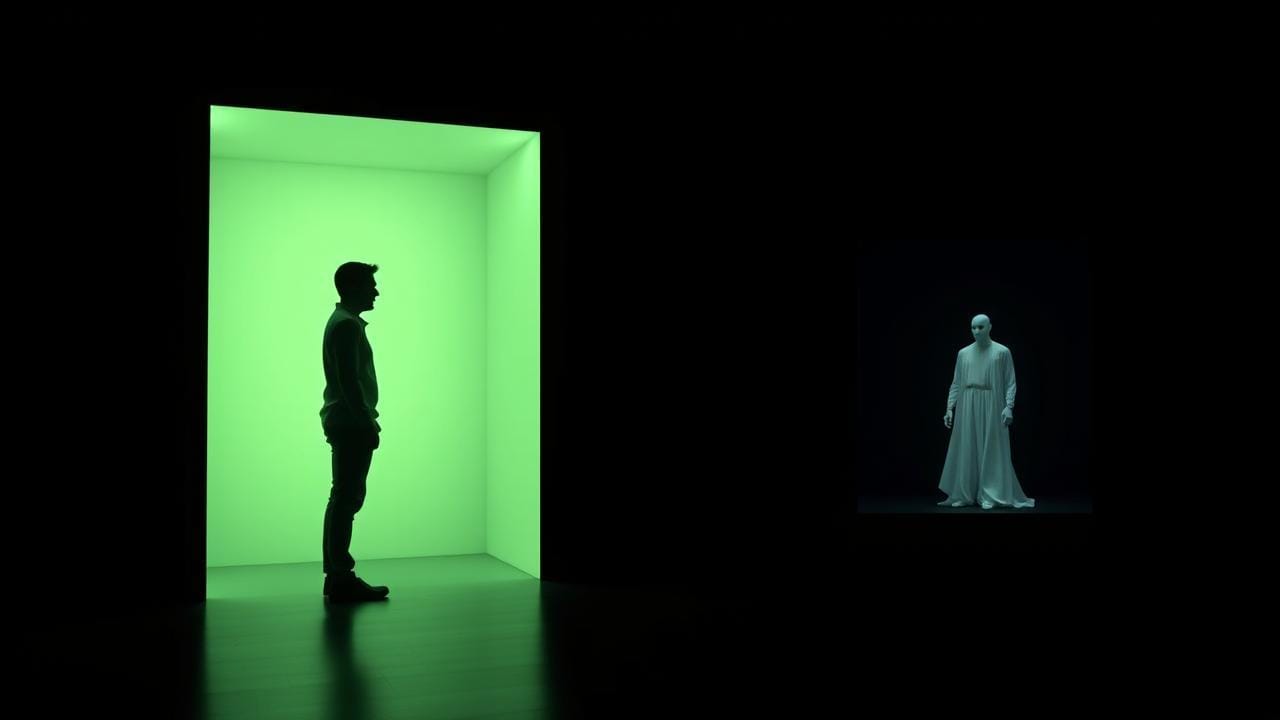
We've spent three weeks setting up the persona model. The leak (week one). The container (week two). The identity (week three). All of that holds together as long as one thing is true, and if that one thing isn't true, the whole structure falls apart.
The one thing is this: the user and the AI have to be in the same persona at the same time. When you walk into a room, the AI walks in with you. When you leave, it leaves too. Always. No exceptions.
I call this the symmetry rule. It sounds obvious. It is not how most AI works today. And the moment the user and the AI drift into different personas, you're right back to the wrong-bowl problem from week one, usually in the most embarrassing possible way.
This article is about why the rule exists, what it actually requires from the user interface, and what breaks the moment you let symmetry slip.
The asymmetry failure
Let me sketch the failure mode first, because it's easier to see what we're protecting against once you've felt the wrong thing.
Imagine: I'm in the family room, having a conversation with my AI about a Saturday hike. My UI looks family-flavored: the calendar widget shows my family calendar, and the chat history shows family chats. So far, so good. I'm in the Family persona.
Now the AI is helping me. But under the hood, the AI is still operating with my Work persona's memory loaded, because that's the persona it was last working in. So when I ask it "is Saturday morning clear," the AI helpfully cross-references my work calendar (which I told the Family persona it can't see) and tells me Saturday is blocked, because my work calendar shows a Saturday-morning sync.
What just happened? My UI says I'm in Family. The AI's behavior is in Work. We drifted. The wall between the rooms became porous in the worst possible direction, invisible to me, full of leakage from the AI side.
Now think about how that scales. Same shape, much worse stakes:
- Personal scale: the AI helps draft something personal, but it accidentally pulls in a private note that belonged to a different persona. UI was in Family but the AI was still anchored to Personal memory.
- Small business scale: the AI sends a client email and accidentally references a different client's project, because the UI was in Client A's project but the AI had Client B's context still loaded.
- Enterprise scale: the AI generates a financial report that quietly pulls a number from a different department's data, because the user's view was scoped to Marketing but the AI's tool surface still included Finance.
In every case, the user thinks they're in one persona. The AI is in another. The mismatch is invisible until something leaks across, and by the time you see the leak, the damage is done.
That's why the rule isn't "the user and the AI should usually be in the same persona." It's "they always are, and the UI makes it impossible for them not to be."
What symmetry actually requires
For the user and the AI to share a persona, four things have to be true at the same instant when the persona changes.
The user's UI shifts; the visible chrome of the application changes. Different colors maybe, different active menu items, different home screen. Different calendar in the calendar widget, different inbox in the mail pane. The user can see, at a glance, which room they're in. The room is visually obvious.
The AI's context shifts. Whatever conversation memory, scratch space, working set the AI was holding gets parked. The new persona's context is loaded. The AI is not asking "do I switch?", the switch already happened underneath it.
The AI's tool surface shifts. The set of MCP connectors (the tools the AI can pick up) changes. Work tools go away. Family tools come on. (The protocol that lets AI assistants reach out to outside tools and data is called MCP, if you want to look it up later.)
The AI's identity shifts: who the AI is acting as changes. Replies will come from a different email, and logs will be written under a different actor. The audit trail picks up where the previous persona's audit trail left off, which is to say, it doesn't, it starts fresh in the new room.
All four of those things change atomically. That's the word that matters. Atomic, in computing, means "either everything in the operation happens, or none of it does, there's no in-between state." If you let any of those four pieces shift independently, you've created a drift window. The UI might say Family while the AI is still in Work. That window might be milliseconds, or it might be hours, but inside that window, the system is lying.
So symmetry is enforced at the persona-switch event itself. One switch, four shifts, all at once. The user doesn't have to remember anything. The system can't get out of sync because the switch is the sync.
The UI is doing real work here
A thing that bugs me about how AI is currently sold is that the UI is treated as a wrapper around the model. As if the chat box is the product and everything around it is decoration. In the persona model, the UI is doing real, structural work. It's the part that shows the user which room they're in, and that's not decoration. That's the whole safety story for the human side.
Think of it like the way an operating system shows you which account you're logged into. You always know if you're root (the admin user on Linux, who can do anything) versus a regular user, because the prompt looks different. You always know which user you're logged in as on a Mac, because the user name is in the menu bar. That visibility isn't fluff. It's what keeps you from doing root-level things in your regular-user mind frame.
The persona switch needs the same visibility. The whole app changes shape. Not just a small badge that says "Family persona active" tucked in a corner. The whole environment. Colors, layout, what's on the home screen. When you switch personas, the experience should feel like walking through a door, not like clicking a toggle.
If your AI tool has a "persona dropdown" but the rest of the app looks identical regardless of the choice. That's a bad sign. It means the persona is a label, not a room. (See last week's piece on the container vs. costume distinction, same lesson, different layer.)
What this looks like in practice
Personal. When I'm at home and I open my AI, the home screen reflects whichever persona I'm in at that moment. Family persona by default for evenings and weekends, the shared household calendar in view, the photos widget showing the household library, the chat history full of household threads. If I want to step into Personal (to journal, to plan something just for me) I tap to switch personas. Everything visible changes: the journal app comes forward, the household calendar goes away, and my AI's tone and memory shift. It's not jarring, it's obvious. I can see I'm in a different room. And if I want to step into the Blogging persona. That's a third switch, and the whole interface becomes a writing-and-publishing surface. Three rooms, three looks. Always obvious which one I'm in.
Small Business. This is where symmetry pays back fastest. If you're a freelancer running three clients plus your personal life, you want the UI for each client to be unmistakably distinct. Not because clients see your UI, they don't. Because you need to never confuse them yourself: different sidebar colors per client, different default folders, different active connectors. When you switch from Client A's room to Client B's, the AI's memory of Client A goes dormant, the tools change (different invoicing app, different CRM, different brand voice), and the UI looks meaningfully different. You can't accidentally answer a Client A email while you're staring at a Client B home screen, because the home screen wouldn't look like Client A's at that moment.
Enterprise. This is where the symmetry rule becomes a compliance feature. If your AI tool lets a user be visibly in one workspace while the AI's tool surface includes another workspace's resources, you have a data-isolation violation just waiting to be discovered. The fix is straightforward: every persona switch is a full-stack switch, including the UI. When the user changes to the Customer Support persona, their dashboard becomes the support dashboard, and the AI's permitted actions become only the support set, and the AI's actor identity becomes the support persona, and the audit log starts logging under the support persona's name. All in the same atomic event. Your auditor doesn't have to take your word for it, the architecture enforces it.
Want to go deeper on when the AI carries a backstory at all? Next week I'll write about Backstory: when the AI needs to know who you are, the rule for when a persona is purposeful enough to need one.
The drift problem
The most common way symmetry breaks isn't a deliberate decision. It's drift.
The user switches personas. The UI updates. Something somewhere (a background agent, a long-running task, a cached context) doesn't update. Days later, that something starts emitting actions in the old persona while the user is in the new one. They're not in sync anymore. Nobody decided to break the rule. The system just slowly leaked away from it.
The fix is to treat the persona as the authoritative state, and have everything else subscribe to it. When persona changes, everything downstream gets the notice. Caches invalidate. Active sessions end. Long-running agents either pause or get migrated to the new persona explicitly. There is no "this background task is still in the old persona." Either the task moves with you or it stops.
This is harder than it sounds. But it's the difference between a system that says it has personas and one that actually has them.
The rule, plainly
If I had to put the symmetry rule on a sticker, it would say:
The user and the AI are always in the same persona. When one moves, the other moves with them. When neither has moved, neither has moved.
That's the rule. Everything in the persona model holds together when it's true. Everything falls down when it isn't.
If you're a personal user: notice whether your AI's "context" and your "view" feel like one thing or two. If they feel like two (if you sometimes have to remind the AI which mode you're in) your system isn't enforcing symmetry.
If you're running a small business: when you switch from personal life to client work, ask whether your AI's tool surface and its memory and its identity all switch at the same moment, or whether you're trusting yourself to remember. Trusting yourself to remember is the thing that fails on Tuesday afternoon.
If you're at an enterprise: look at your AI deployment and ask, can a user be visibly in workspace A while the AI is operating with workspace B's permissions? If yes, you have a drift exposure. Fix it before someone finds it for you.
Next Tuesday: backstory. When does a persona need to know who you are, and when is the right answer that it doesn't? Most current AI assumes "always tell me everything." I'm going to argue the opposite: backstory is purposeful, not default, and most personas should know much less about you than they do.