

GPT-4.5 vs Claude 3.7 vs Gemini 2.0: a cloud architect's take
Three frontier models on the table at the end of February, three different bets about what "frontier" means. The interesting comparison isn't who wins, it's who fits which workload.

OpenAI shipped GPT-4.5 yesterday. Orion, the long-awaited "scaling wall" model. Claude 3.7 Sonnet shipped four days earlier with extended thinking on by default. Gemini 2.0 Flash and 2.0 Flash Thinking have been generally available since December. As of the end of February that's the actual frontier menu, and any architecture conversation about which one to wire into a workload has to start with what each one is actually for.
Treat the three as different bets, not as competing products at the same point on the same line.
What each one is actually optimized for
GPT-4.5 (Orion) is OpenAI's bet that scaling base-model size still buys real capability gains, even past the point where the cost-per-marginal-improvement curve has visibly bent. The model is large, it's expensive ($75/$150 per million tokens, note that's input/output, not output/output), and the benchmark results are... fine. It's better than GPT-4o at the things GPT-4o was already strong at. It's not better than o1 at reasoning. It's not cheaper than anything in its class. The bet here is that the writing quality, the lower hallucination rate, and the EQ on conversational turns matter more than the benchmark deltas, and that there's a market willing to pay top-tier price for top-tier base-model behavior.
Claude 3.7 Sonnet is Anthropic's bet on the hybrid-reasoning model, one model that does both fast turns and deep thinking, controlled per-request. Standard Sonnet pricing ($3/$15), the thinking tokens count against the context budget, and the visible reasoning is part of the product. The bet here is that procurement and integration teams want one model surface and one bill, with the choice of effort happening at request time.
Gemini 2.0 Flash is Google's bet on cheap, fast, multimodal-by-default, with a frontier-tier reasoning variant (2.0 Flash Thinking) at a lower price than the equivalents from anyone else. The "Flash" branding is the giveaway. Google is competing on speed and price at the inference layer, not on raw capability. The bet here is that for the long tail of "I just need a model to do this thing in my pipeline," cheap and fast wins.
These aren't equivalent products. Treating them as such (picking the "best" one) gets you the wrong answer.
A practical comparison
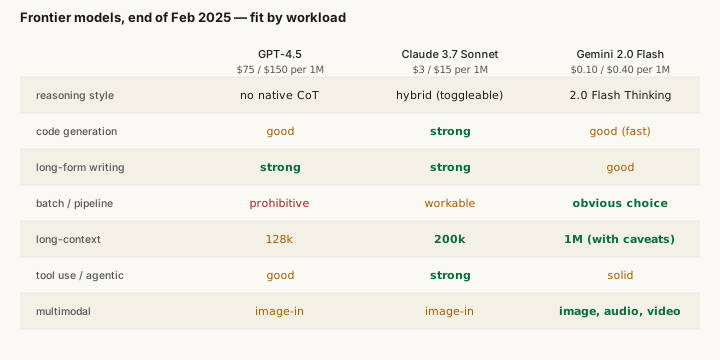
The matrix simplifies more than is fair to any of the three, but it captures the practical decision shape: pick the one whose strengths match the workload, not the one with the highest leaderboard score.
What I'd actually deploy where
A few specific patterns I'd reach for in late February:
For a coding-heavy agentic workload (IDE assistant, CI-driven code review, multi-step refactoring) Claude 3.7 with extended thinking enabled per-task. Pricing is reasonable, the agentic behavior is the most polished of the three at the moment, and the toggleable thinking gives you control over when to spend reasoning budget. GPT-4.5 is also strong here but the price-per-task math gets ugly fast.
For a long-document analysis pipeline (contracts, legal discovery, research summarization) Gemini 2.0 Flash for the bulk first pass, Claude 3.7 for the final synthesis. Gemini's 1M context lets you avoid the chunking acrobatics for the input, the price is low enough to run at scale, and Claude does a noticeably better job at the "now write the executive-summary version" step at the end.
For a high-stakes single-turn creative or analytical task, long-form writing where the output quality is the deliverable and the cost is rounding error. GPT-4.5 is genuinely the best of the three. The price tag makes it hard to deploy at scale, but for the use cases where you'd hire a human writer at $200/hr instead, the math is fine.
For batch transformation jobs (embedding generation, classification, structured extraction at volume) Gemini 2.0 Flash, almost regardless. The price-per-task math is the only thing that matters and Gemini wins it by an order of magnitude.
For "I want one model that does everything". Claude 3.7 is the most defensible single-model choice. It's not the cheapest. It's not the absolute strongest at any one thing, but it's competitive across the range of workloads most teams actually have to serve.
What this comparison ignores
The frontier comparison above ignores the open-weights tier entirely, which would be a mistake for a deployment that's price-sensitive or residency-sensitive. DeepSeek-R1's $0.55/$2.19 pricing for reasoning-class capability puts a third floor under the conversation that the closed-frontier shops have to argue against. The right architectural answer for a lot of workloads in 2025 is going to be a mix, closed frontier for the hard, low-volume turns, open weights or Gemini Flash for the long tail.
That mix is harder to put into practice than picking one vendor. It's also where the real value of being a careful architect is going to land for the next year. The vendors are competing for the workload categories. Your job is figuring out which categories your application actually has.