

The Apple Silicon + open-weights inflection point
An M4 Max with 64 GB of unified memory comfortably runs open-weights models that needed a serious GPU rig a year ago. The price-per-capability curve crossed something quietly, and the consequence for who can run frontier-adjacent inference at home is bigger than it looks.

The piece a couple of weeks ago about my home setup glossed past one thing that deserves its own treatment. The Apple Silicon plus 2025-tier open-weights combination crossed a price-per-capability line in roughly the last quarter that wasn't true a year ago. The line crossed quietly because it crossed slowly, and the consequence, what kinds of inference workload an individual or small team can now run on hardware they own, is larger than the keynote-vendor conversation acknowledges.
Worth being explicit about what changed and why. I'll talk about the M4 Max Mac Studio specifically because that's what I bought when the M4 generation shipped in March; the picture extends upward (M4 Max with more memory, the M3 Ultra Studio with the higher-memory tiers) and downward (M4 Pro Mac mini, an M4 Pro MacBook Pro) at the obvious sizes.
The actual numbers, the box I have
The configuration I keep referring to: M4 Max Mac Studio, 64 GB unified memory, the workhorse-tier of the M4-generation Studio line that shipped in March 2025. Sticker price about $2,500. Power draw at sustained load somewhere around 130 W. Idle around 25 W. One box on a shelf, no rack, no cooling problem, no separate GPU procurement story.
What that box can run today, locally, with reasonable throughput:
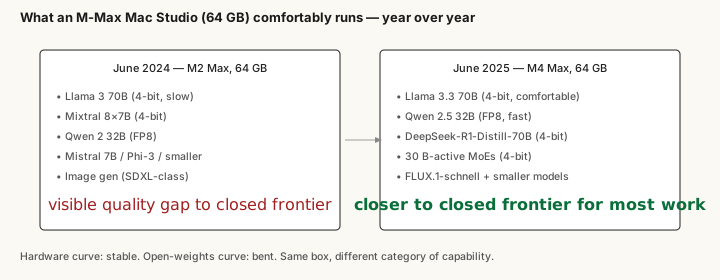
- Llama 3.3 70B in 4-bit, comfortably. Throughput in the high-teens to low-20s tokens/sec at batch 1.
- Qwen 2.5 32B at higher precision, very comfortable. Throughput in the 30+ range.
- DeepSeek-R1-Distill-Llama-70B in 4-bit, similar shape to Llama 3.3 70B.
- Smaller MoE variants (the 30 B-active-parameter open-weights MoEs from Mistral and Qwen) fit at 4-bit.
- Several smaller models (7 B–13 B class) at higher precision with room for serving multiple in parallel.
- Image generation. FLUX.1-schnell runs comfortably alongside the language workloads when you're not pushing the language side.
A year ago (June 2024) equivalent-class hardware (M2 Max Studio with similar memory budget) was running the same 70B-class models at lower precision and slower throughput, with the closed-frontier quality gap meaningfully wider. The change isn't the hardware curve (Apple ships about one Studio generation per year); the change is the open-weights model curve closing the quality gap on what fits in 64 GB.
The bigger Studios (M4 Max with 96 or 128 GB, or the M3 Ultra Studio with up to 512 GB) extend this picture upward, they let bigger MoEs fit, they let higher precision sit comfortably, they widen the experimentation envelope. The 64 GB box is the workhorse-tier Studio; the higher tiers are the premium tier.
What this enables that wasn't enabled
A few categories of workload that move from "needs cloud or rented GPUs" to "runs at home":
Always-on personal AI assistants with non-trivial model quality. Watch your local files, your local conversations, your local activity, with a model good enough to reason about them well. The 70 B-class running locally is the working foundation; not the embedding-only retrieval pattern, full-language reasoning over private data.
Privacy-bound inference for individuals and small shops. Lawyers, doctors, financial advisors, anyone whose data calculus blocks cloud inference but whose AI use case has become legitimately useful. The hardware exists, the model exists, the deployment story is gettable.
Development and experimentation without the API meter. Iterate on prompts and chains and agentic loops without watching the cost tick up. The marginal cost of an additional inference is essentially zero on the local box.
Small-scale production for niche use cases. Not the multi-tenant-thousands-of-users SaaS shape, but the small-shop "we have a use case for our team" shape. Doesn't justify a hosted-API contract; does justify owning a Studio.
The shift isn't that any of these were impossible before. It's that the price-per-quality crossed a line where they're now sensible defaults rather than enthusiast choices.
Why this is structural, not a moment
Three reasons the inflection isn't going to reverse:
Apple keeps shipping more unified memory at the top of the line. The Studio top-end has climbed every generation. The M4 generation pushed the maximum higher; the next generation likely pushes higher still. The whole line moves up over time, which means the workloads that fit on a given price tier expand.
Open-weights model quality is on a curve that hasn't bent yet. Each release narrows the gap to closed frontier. Llama 4 narrowed the gap from Llama 3. The Mistral and DeepSeek and Qwen lines all keep improving. Release frequency is high. The gap from closed to open at any given parameter count is shrinking.
Inference-stack maturity is improving. llama.cpp, MLX, Ollama, the various Apple-Silicon-native serving stacks, the local-inference tooling matured significantly over the last year. What was a research project in 2023 is a working stack in 2025. Performance per dollar is improving even with the same hardware because the software is getting more efficient.
These trends are all moving in the same direction. The inflection doesn't reverse.
The cases where cloud still wins
I keep being explicit about this because the local-versus-cloud conversation tends to overshoot. Cloud still wins on:
- The actual frontier of capability. Opus 4 and GPT-5 are still ahead of any open-weights model on the hardest tasks. The gap has narrowed; it isn't gone. Hosted is still the right answer for those workloads.
- The largest open-weights models. DeepSeek V3 671B and Llama 4 Maverick at full precision don't fit on a 64 GB Studio. They fit on the higher-memory Studios; they fit better on a serious cloud GPU. For most users the hosted version is the right answer.
- Bursty workloads with low average usage. Hardware that sits idle most of the time isn't paying back.
- Multi-tenant production at scale. The economies of scale on hosted inference still favor cloud for the production-SaaS shape.
- When operational simplicity is the binding constraint. If you don't want to think about hardware, the cloud is the thing you're paying for. That's a legitimate buy.
The shift isn't "local replaces cloud." It's "the workload set where local-first is the right answer just got bigger." For an individual or small team with the privacy-bound, high-volume, single-tenant use cases, exactly the cases where the local-first calculation already favored local, the new model line means the answer is now better, not just possible.
The buyer's pattern that's emerging
I keep seeing the same pattern when individuals or small shops ask me about getting into local AI:
- Step 1: start with whatever Apple Silicon laptop or desktop you already have. Run Ollama or LM Studio, try the smaller models. Get a feel for what local inference is like.
- Step 2: if the use case justifies it, get a Mac Studio with as much unified memory as your budget supports. The 64 GB M4 Max is the credible workhorse-tier entry point; 96 or 128 GB is more durable; the M3 Ultra Studio sizes are the premium tier for the larger model loads. Don't undersize this, the model line keeps growing and the Studio's lifecycle is several years.
- Step 3: add a NAS for shared model storage and fast local networking. The networking is often what people undersize.
- Step 4: a second box if redundancy or burst capacity matters. Most workloads don't need this; some do.
The pattern doesn't end at "build a data center." For most use cases it ends at step 2, with a single Mac Studio doing the work. The multi-machine shape is for the small subset where it actually pays back.
The longer-term implication
Two things this points at over the next eighteen months:
The first is a class of small-scale AI products that ship as software-on-your-hardware rather than as cloud services. Privacy-bound apps that never need a server because the model runs locally. The category exists today (some local-first writing tools, some local-first development tools); it expands as more workloads fit the local-friendly profile.
The second is the cloud-vendor pricing pressure compounds. If individual users can run Sonnet-equivalent quality locally at marginal cost, the "use the cheap workhorse-tier API" market becomes less defensible. The cloud wins on the things it actually wins on (frontier capability, scale, operational simplicity); the things in the middle get squeezed.
The keynote conversation about AI-everywhere is mostly about cloud-served AI. Copilot, Workspace, ChatGPT. The quieter, slower-moving conversation is about software-runs-locally AI. The Apple Silicon plus open-weights inflection is the foundation that conversation is built on. It's been crossing for a year and is now visibly across. Worth paying attention to where it goes next.